 The funny thing about life is that we can do it. Or better: How we can hold the mask. We are all of us in the same boat. That means we are born because our parents wanted it, and we will die against our will. Between these two points we are going to make what’s worse, to be rational, reasonable persons holding the fort. We’ll get a pile of bills every month, and they had to be paid before settlement date. We have to behave our self in front of other people, family and our self. Nervous breakdowns, pills and alcohol are not recommended by anyone. Some of us use culture as stimulation, because the artist has always gone longer than any hard working man or family man. The artist can freak out, with both alcohol and nervous breakdowns and it is accepted. Because of this I allow myself to mention 3 lyrics from the world of music, written by artists who satisfy the claim of the artist. One of them is still alive. I feel this important to write about, that’s why I doing it.
In 2007 I said yes to be one of 3 in a TV2 documentary called “Hypochondrians”. The big question I ask myself is how human being can live their lives as if they live forever. To live as a hypochondrian with a fear of doctors is a challenge for anyone it concerns, but also for the surroundings. Society is built on common sense, not on emotions. Johnny Cash, with a voice stamped of sickness, sang on his latest album; «You can run on for a long time, run on for a long time. But sooner or later God’ll cut you down”. If you believe in God or not our destiny is steadfast and merciless. You are going to die, but you don’t know the day and the hour. Johnny Cash was close to dying when he did that song, and he had an extra reason to sing it but he did sing about this subject many times over the years, also in his younger days. Of course this song got an extra depth and gravity when he did it on his last album, released after his death. You can see it every day, people you know passing through in the street or someone you say hello to at the bus in the morning. Some days later you can read their obituary. Still you go on with your life, with routines, calmness and common sense. You pay your bills, go to work, eat your dinner and looking for new furniture at the January sale. Most of us don’t ask for more, and some don’t do anything more the rest of their life. In the time of establishment days are impetuous and punctual. Everything has to be exactly or else things will be delayed. Later, when kids are growing up and move away, many of us use time to the same things, routines, calmness and common sense. Some in this age, travel and experience, but also travel experiences can be a rational thing. At last, in old age, routines take over totally. When that happens it’s no way back. My impression is that no one is so punctual, reason and tidy like old people finish with working. But this article is not going to be about routines because I think some routines are necessary to hold out. In this next song “Killing Time” one line is like this; ”Slowly marchin’ by the numbers to the freedom of the grave. Killing time ain’t it slow» In the end you can hear this: «They’re not haunted by the visions that they never dared to see. And they’ll never miss the dreams they’ve never had.» Kris Kristofferson has a master degree on the English poet William Blake. You can hear it in this lyric. It is strange I don’t have heard him sing this song live, but you’ll find it on the album “Surreal Thing” from 1976. This album continued in a way his way down after the successful years in the early seventies. (Later he had success again.) Another place in this song he sings “And their good times ain’t no better than their bad. Cause they think they need a signal light to tell them they can go”. When you are fear of death or have been close to death you need to live here and now, and fulfill all of your dreams immediately. Time doesn’t stand still, sorrow and pain is walking hand in hand and the dreams and the visions live, they don’t lie fallow. What give you the kick in your ass is the fact Johnny Cash is singing about, you don’t know when it happen, and you know it will happen. In the head of an hypochondrians you don’t have any choice, neither in the head of a man or woman who’s been close- to- death – experience You change your life. In the land turned the wrong way the perfect society is the one you live in. In this society you have to be rational, reason and keep down your emotions. If you don’t do you end up a little strange, and in worst case a deviant. Philosopher, professor and mountaineer Arne Næss, who died when he was 96. He always said you should do the opposite, to live out the emotions. He also lived his life to the fullest.
In the third song I listen to a national icon and a man who certainly not was seen as a little strange or a deviant, but he might have uses “a little strange” about himself. Erik Bye wrote his last song short before he died. He wrote it when he knew he was going to die, and he recorded it deadly ill in the hospital. “Dream” is about following the dream before it’s too late. Lyric is short, but strong, and it’s stronger because we know when he wrote it and recorded it. It’s in Norwegian, but the lines may be translated like this: “Do you carry an old dream? Maybe a drizzle, unruly dream /From behind when you was a kid / and no dream was too big / Give it wings, don’t wait / Soon it will be too late. / Ride on the wide back of the wind, / where eagles and ravens live.” This 3 songs is a good start on a new year. Late poet Hans Børli, who was a friend of Bye, said something like “life is rich enough to forget time and the bread and death”. I absolutely do not sit in with an answer, but fear gets me to ask this eternal question these songs help me out with. How is it possible to so many human beings to live life so rational and correctly. Life is rich enough to live it. And to quote Børli again: “because nothing last, nothing last in a world where peace is snow in the footprint of a beast of prey”.
 ANALYSE RUNDT FØRTI
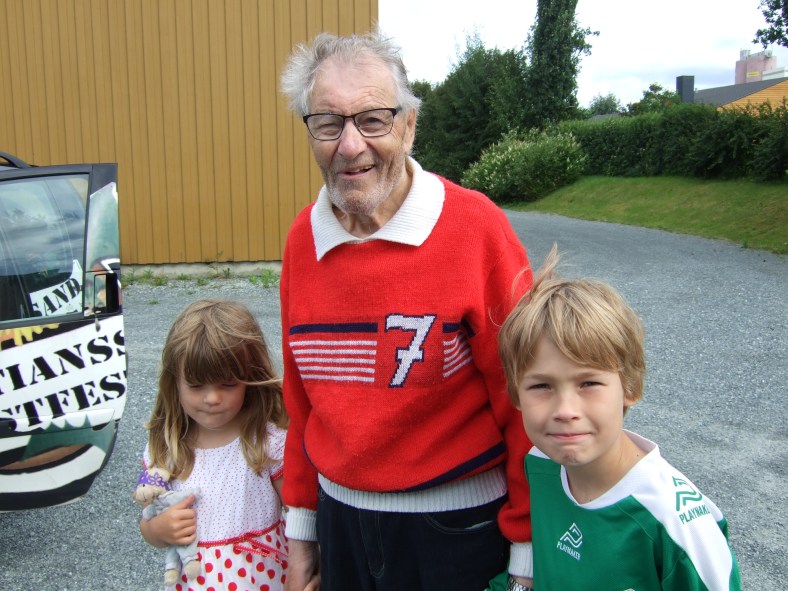 Min onkel Andreas (f.1930) med mine to minste barn.
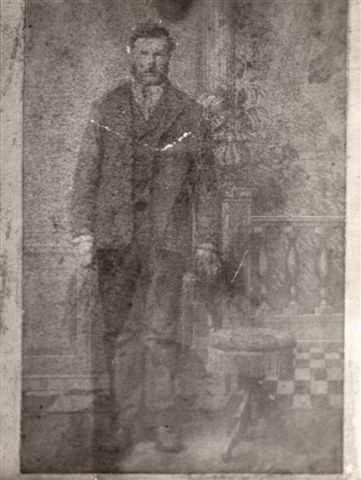 Anders Ollikainen (1848-1918).
 Oldefar Bjørgulv Myhola med sine søstre Torbjørg Dåsvatn (1885-1977) og Ingebjørg Snarteland. To andre søstre, Sigrid Reierson (1868-1949) og Anne Swensson (1875-1957) utvandret til henholdsvis Minnesota og Canada. Det er etterkommere etter dem der i dag.
 PEACEMANS BLOGG